EVA Encapsulation Film for Curved Automotive Solar Roof Modules: Challenges and Solutions
The growing adoption of vehicle-integrated photovoltaics (VIPV) is creating new opportunities for solar energy in the automotive industry. Electric vehicles, hybrid vehicles, and solar-assisted passenger cars increasingly explore photovoltaic roof systems to generate electricity and support onboard electrical functions.
Unlike conventional flat solar panels, automotive solar roofs often feature curved, aerodynamic surfaces. These designs of solar encapsulation film introduce additional challenges in lamination, material adhesion, mechanical stress, and long-term reliability.
EVA encapsulation film plays an important role in protecting solar cells and bonding different module layers. However, selecting the appropriate EVA formulation and optimizing manufacturing processes are essential for producing reliable curved automotive solar roof modules.
1. Why Curved Automotive Solar Roofs Require Specialized Encapsulation
Traditional photovoltaic modules typically use flat glass and relatively rigid structures. Automotive solar roofs must accommodate vehicle styling, aerodynamic requirements, weight limitations, and complex surface geometries.
A curved automotive solar roof may incorporate:
- Curved glass or lightweight polymer frontsheet materials.
- Crystalline silicon or flexible photovoltaic cells.
- EVA encapsulation films between module layers.
- Lightweight composite substrates or protective backsheets.
- Electrical interconnections designed for automotive operating conditions.
These multilayer structures must maintain electrical performance and mechanical integrity despite continuous exposure to temperature fluctuations, vibrations, humidity, and sunlight.
EVA encapsulation film provides optical transparency, electrical insulation, and adhesion between module components. Its processing characteristics also help manufacturers accommodate moderately curved geometries during lamination.
However, EVA cannot compensate for excessive solar cell bending or unsuitable module construction.
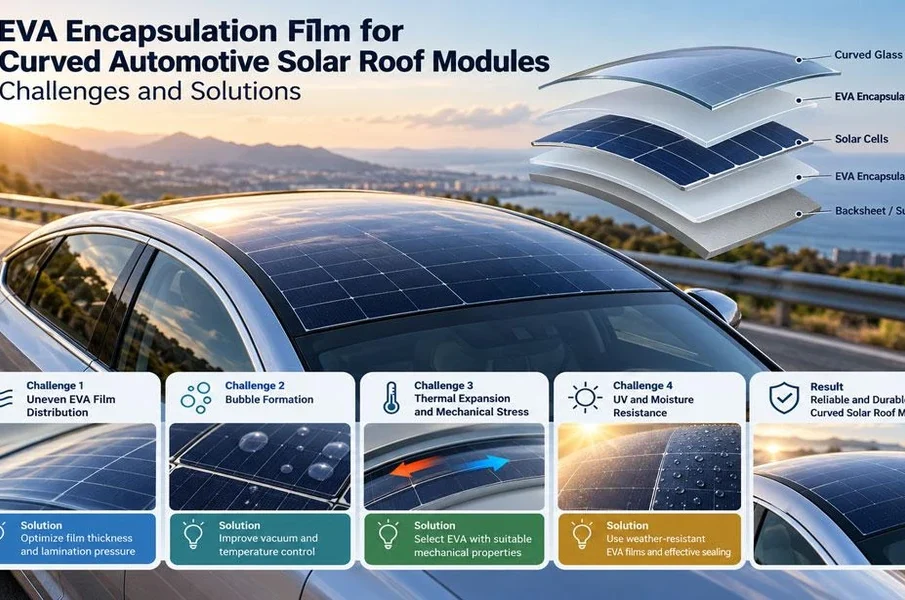
2. Challenge: Uneven EVA Film Distribution on Curved Surfaces
One major difficulty in manufacturing curved solar roof modules is maintaining uniform encapsulant thickness.
During lamination, EVA softens and flows under heat and pressure. On curved substrates, uneven pressure distribution may cause excessive material movement, localized thinning, or wrinkles.
Insufficient encapsulation thickness can increase the risk of mechanical damage and weaken protection around solar cells.
Solution: Optimize Film Thickness and Lamination Pressure
Manufacturers should select EVA film thickness according to module curvature, cell dimensions, and substrate configuration.
Recommended measures include using conformable EVA formulations, optimizing vacuum pressure, and applying appropriate curved lamination fixtures.
For complex geometries, double-membrane lamination equipment can improve pressure distribution and support more consistent encapsulation.
3. Challenge: Bubble Formation During Curved Module Lamination
Air bubbles and voids are common encapsulation defects that can compromise the appearance and reliability of automotive solar roofs.
Curved surfaces make air evacuation more difficult, particularly around edges, corners, and complex geometric transitions.
Potential causes include incomplete vacuum extraction, excessive heating rates, trapped moisture, and inappropriate EVA curing conditions.
Solution: Improve Vacuum and Temperature Control
A controlled lamination process should provide sufficient time for air evacuation before substantial EVA crosslinking occurs.
Manufacturers should optimize heating profiles, vacuum duration, and curing temperatures based on the specific EVA formulation.
Research demonstrates that excessive curing temperatures can promote void formation, while inappropriate crosslinking conditions may reduce long-term adhesion stability.
4. Challenge: Thermal Expansion and Mechanical Stress
Automotive solar roof modules experience repeated heating and cooling during operation.
Glass, polymer substrates, solar cells, and EVA encapsulation films have different coefficients of thermal expansion. These differences can generate internal stresses, especially around curved sections.
Over time, accumulated stress may contribute to delamination, cell cracking, and electrical interconnection failures.
Solution: Select EVA with Suitable Mechanical Properties
EVA formulations with appropriate flexibility, adhesion, and crosslinking characteristics can help accommodate differential thermal movement.
Manufacturers should also optimize substrate selection, cell positioning, and interconnection design.
Thermal cycling tests should evaluate adhesion retention, electrical performance, and visible defects after repeated temperature changes.
Importantly, increasing EVA crosslinking density does not automatically improve durability. Excessive curing can increase residual stress and negatively affect adhesion.
5. Challenge: Long-Term UV and Moisture Resistance
Automotive solar roofs remain exposed to outdoor conditions throughout their service life.
Ultraviolet radiation, moisture ingress, and elevated temperatures may gradually affect EVA optical properties and interfacial adhesion.
Potential degradation mechanisms include yellowing, hydrolysis, and corrosion associated with acidic degradation products.
These effects can reduce light transmission and compromise module reliability.
Solution: Use Weather-Resistant EVA Encapsulation Films
Automotive applications should prioritize EVA grades with suitable UV stability, optical transmission, and adhesion retention.
Additional protective measures include effective edge sealing, compatible frontsheet and backsheet materials, and carefully controlled curing conditions.
Qualification testing should combine damp heat, UV exposure, and thermal cycling with automotive-specific vibration and mechanical evaluations.
6. Best Practices for Automotive Solar Roof Encapsulation
To improve manufacturing consistency and long-term performance, automotive photovoltaic manufacturers should establish an integrated material and process validation strategy.
Key considerations include:
- Selecting EVA films compatible with curved substrates.
- Maintaining consistent encapsulation thickness.
- Optimizing lamination temperature, vacuum, and curing time.
- Evaluating adhesion across different module interfaces.
- Verifying resistance to thermal cycling, humidity, UV exposure, and vibration.
- Inspecting finished modules for bubbles, wrinkles, and delamination.
These measures help reduce manufacturing defects and improve the reliability of curved photovoltaic assemblies.